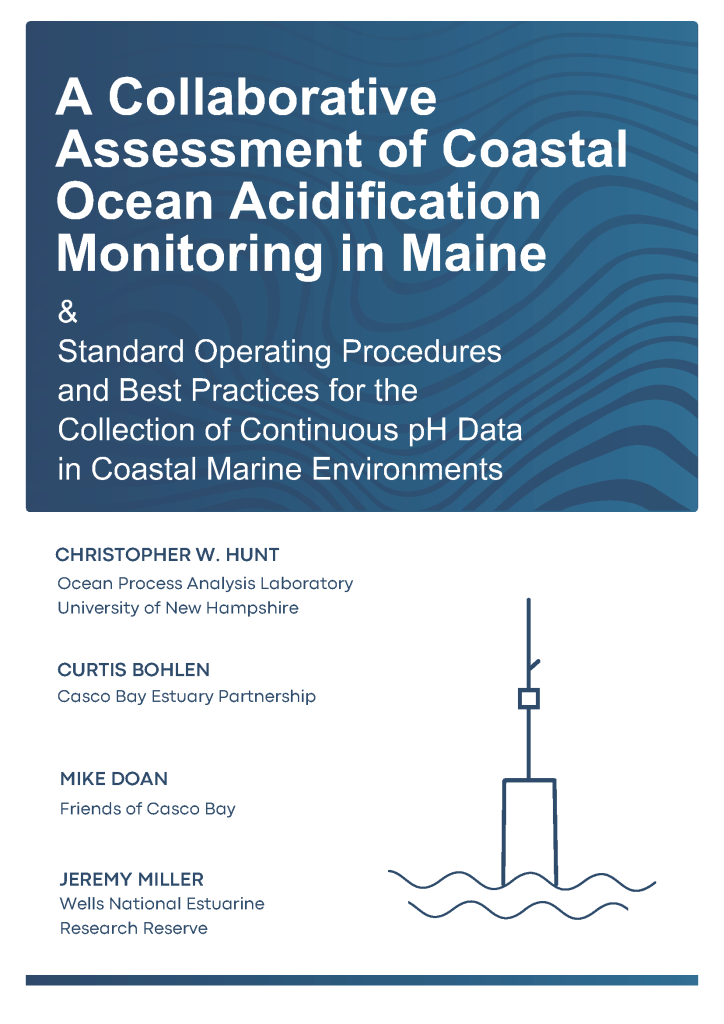
Maine Ocean Climate Collaborative’s “Sensor Squad” has issued a two-part report on monitoring acidification.
Written by Dr. Chris Hunt of the University of New Hampshire’s Ocean Process Analysis Laboratory, Curtis Bohlen, Director of Casco Bay Estuary Partnership, Mike Doan, Friends of Casco Bay’s Staff Scientist, and Jeremy Miller of Wells National Estuarine Research Reserve, the report shares the results of their two-year study to identify affordable and reliable tools for monitoring nearshore ocean acidification.
The first part of the report, “Assessment of Coastal Ocean Acidification Monitoring in Maine,” examines the accuracy of glass-electrode data sonde pH sensors. By testing real-world results of these sensors against laboratory-controlled methods, researchers found that sondes can reliably and effectively measure coastal pH when best practices are followed.
The second part of the report outlines those best practices and standard operating procedures.
You can download the report here.
Friends of Casco Bay’s and Wells NERR’s respective continuous monitoring programs use the quality assurance and best practices outlined in the report. The Sensor Squad is committed to sharing what they have learned with organizations, researchers, and agencies that are currently collecting continuous acidification data, or are interested in doing so in the near future.
Contact Mike Doan for more information.